DSW Candidate – Darius Poitier
$0.00
Virtual Showcase of DSW Scholars 2026 Event!
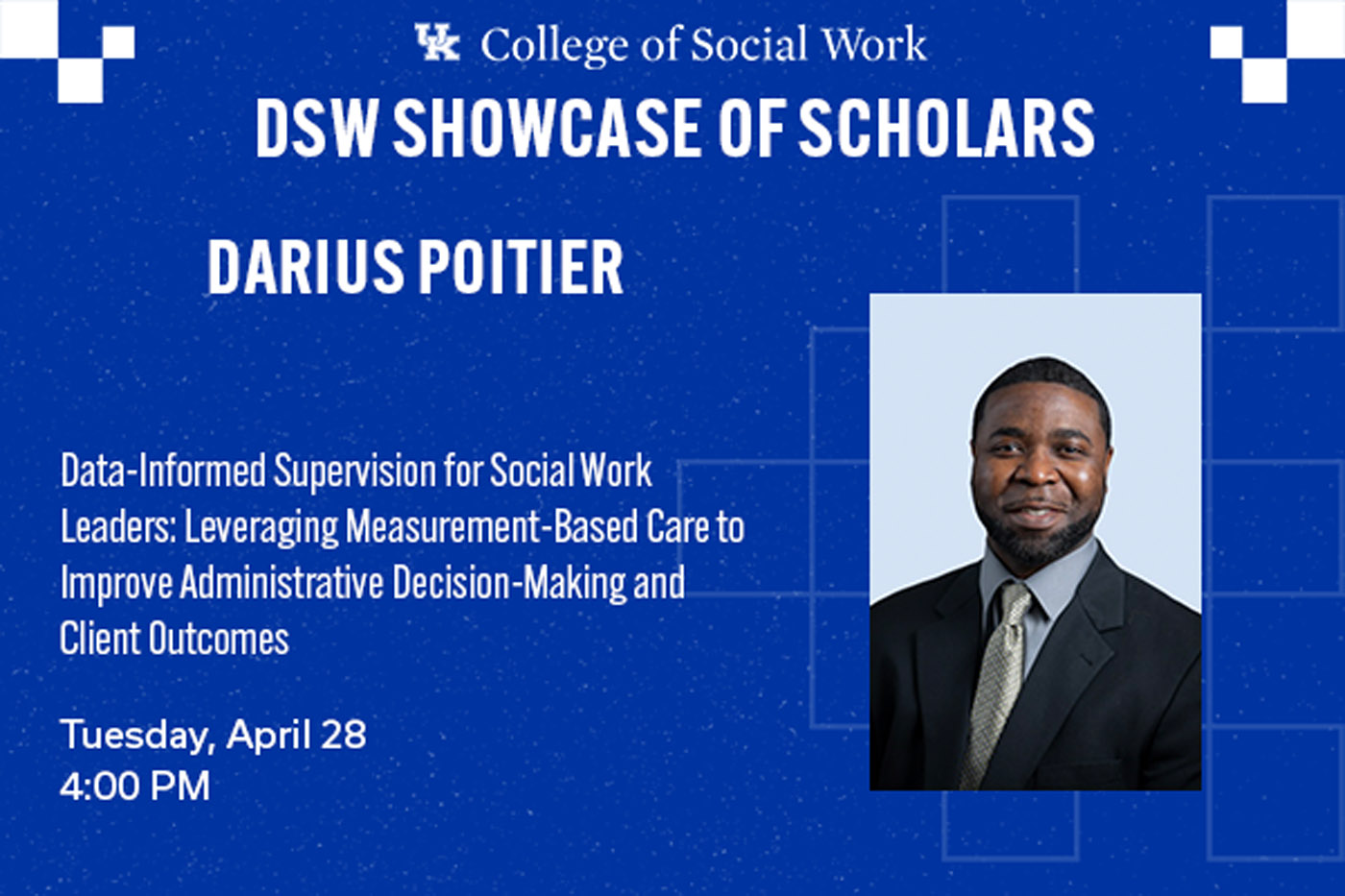
Data-Informed Supervision for Social Work Leaders: Leveraging Measurement-Based Care to Improve Administrative Decision-Making and Client Outcomes
DSW Candidate – Darius Poitier
Tuesday, April 28, 2026
4:00 PM-5:15 PM Eastern Time Zone
Credit Hours: 1.0 (ACE)
Description
Data-Informed Supervision for Social Work Leaders: Leveraging Measurement-Based Care to Improve Administrative Decision-Making and Client Outcomes
Learning Objectives:
Upon completion of this conference, participants will be able to:
1. Describe the core principles of data-informed supervision and Measurement-Based Care within social work leadership contexts.
2. Identify organizational and supervisory barriers that limit effective use of data in administrative and clinical supervision.
3. Apply data-informed strategies to enhance supervisory decision-making, staff development, and client outcomes.
Presenter Bio
Darius Poitier, MSW, LCSW, LISW-CP, is a Doctoral Candidate in the Doctor of Social Work (DSW) program at the University of Kentucky, with a concentration in Administrative Leadership. He holds a Master of Social Work degree and is independently licensed in both Florida and South Carolina. Mr. Poitier is also an ordained Christian minister.
Mr. Poitier currently serves as a Behavioral Health Surveyor with The Joint Commission, where he evaluates quality, safety, and regulatory compliance across behavioral health and human service organizations nationwide. In addition to his surveyor role, he facilitates and teaches educational sessions for the Behavioral Health Care cadre at The Joint Commission’s annual conference. He also maintains an active clinical practice as an outpatient therapist with LifeStance Health in Columbia, South Carolina, and provides clinical supervision to social workers pursuing licensure. Mr. Poitier additionally serves as a guest lecturer in the Department of Psychology at the College of Charleston.
His professional background spans juvenile justice, child welfare, substance use treatment, psychiatric residential treatment, and outpatient behavioral health, including leadership roles as a Juvenile Probation Officer, Residential Facility Administrator, Assistant Program Director, and Director of Clinical and Residential Services. His work is grounded in trauma-informed care, systems theory, and equity-centered leadership. Mr. Poitier’s research interests focus on administrative supervision, measurement-based care, and data-informed leadership. His doctoral capstone project, Data-Informed Supervision for Social Work Leaders, examines the underutilization of data in administrative supervision and proposes an integrated model incorporating continuous quality improvement, reflective supervision, and culturally responsive leadership frameworks.
Delivery Method: Live Interactive Training via Zoom Video Conferencing
Credit Hours: 1.0 (ACE)
Target Audience: This conference is intended for social workers and students.
Accreditation: University of Kentucky College of Social Work, Provider # 1377, is approved as an ACE provider to offer social work continuing education by the Association of Social Work Boards (ASWB) Approved Continuing Education (ACE) program. Regulatory boards are the final authority on courses accepted for continuing education credit. ACE provider approval period: 9/29/25-9/29/28. Social workers participating in this conference will receive up to 15 general continuing education credits.
Claiming CE Credit: Instructions for claiming CE credit will be disseminated at the beginning of each session.
Questions: If you have any questions regarding CE credit or to report a grievance, please contact Christina Krantz at Christina.Krantz@uky.edu. For technical assistance, please contact lmshelp@uky.edu.
Disclaimer: The views and opinions expressed in these presentations are those of the individual presenters and do not necessarily reflect the official policies or positions of the University of Kentucky or the College of Social Work. The inclusion of any topics, perspectives, or discussions is intended for academic engagement and does not constitute endorsement by the institution.