DSW Candidate – Isabel Rose (Iszy) Paulk
$0.00
Virtual Showcase of DSW Scholars 2026 Event!
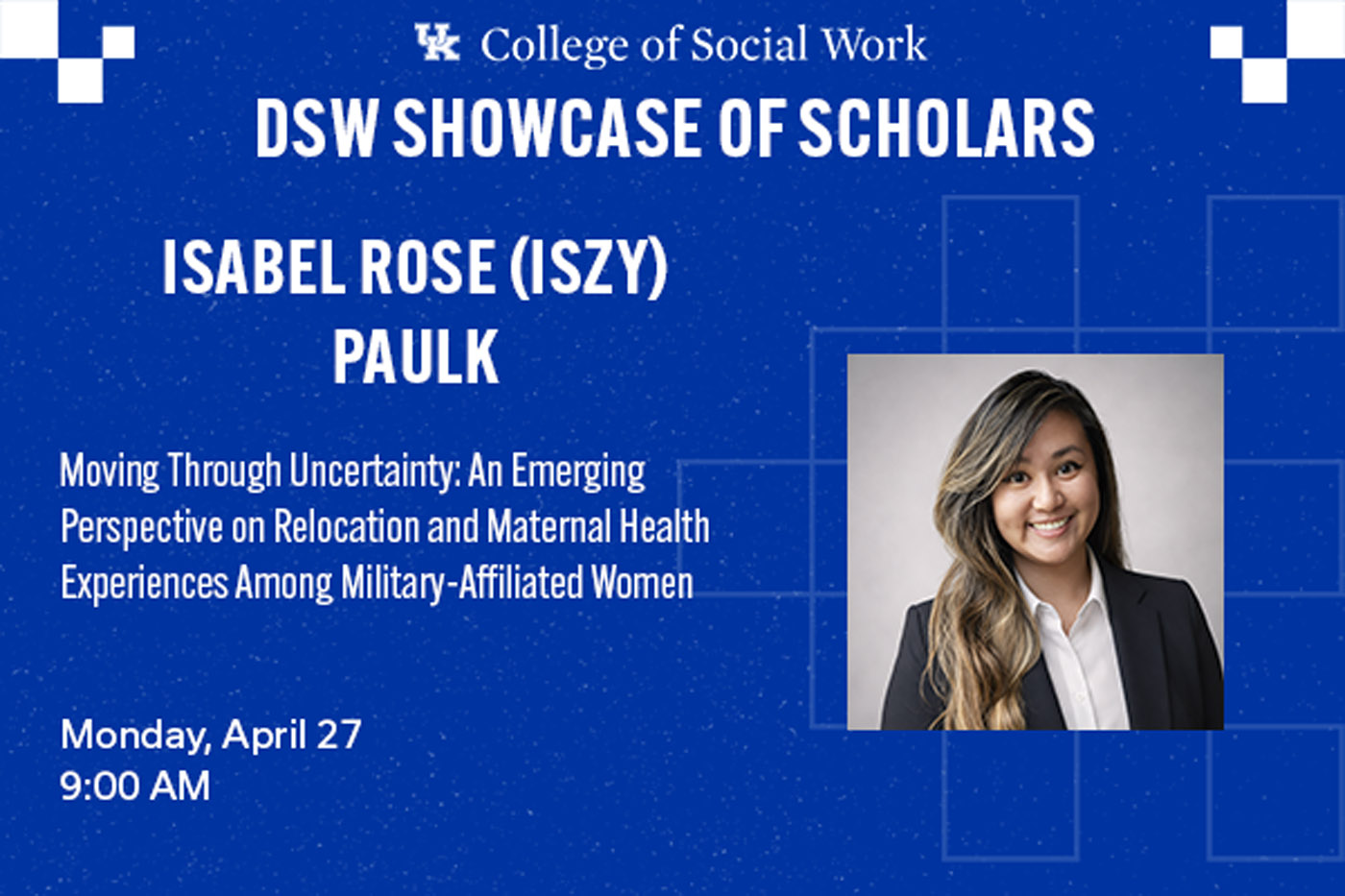
Moving Through Uncertainty: An Emerging Perspective on Relocation and Maternal Health Experiences Among Military-Affiliated Women
DSW Candidate – Isabel Rose (Iszy) Paulk
Monday, April 27, 2026
9:00 AM-10:15 AM Eastern Time Zone
Credit Hours: 1.0 (ACE)
Description
Moving Through Uncertainty: An Emerging Perspective on Relocation and Maternal Health Experiences Among Military-Affiliated Women
Learning Objectives:
Upon completion of this conference, participants will be able to:
- Identify key social determinants that influence pregnancy during military relocations.
- Apply principles from Structural Violence Theory and Social Cognitive Theory to analyze how institutional barriers and lived experiences shape maternal health management practices.
- Apply a systems-informed lens to propose advocacy strategies that address gaps in maternal healthcare during periods of military transition.
Presenter Bio:
Isabel Rose (Iszy) Paulk is a sincere advocate for maternal health, women’s well-being, and mental wellness with over a decade of experience serving rural, underserved, and under-resourced populations. She has contributed to community-based initiatives, evaluation and assessment efforts, and person-centered practice. These efforts led to empathetic interventions and interdisciplinary strategies that are responsive to women’s lived experiences and needs.
Iszy’s educational background includes a Master of Public Health degree from the University of Arizona (2020) and a Master of Social Work degree from the University of Houston (2023). She is also a Certified Health Education Specialist (CHES) and Accredited Financial Counselor (AFC). She is currently a doctoral candidate at the University of Kentucky and is expected to graduate in May 2026.
Her research interests focus on maternal health, social determinants of health, and health behaviors, with an emphasis on how fragmented systems and structural conditions shape human behaviors and influence family outcomes. In addition, she has contributed as a second author to research related to healthcare access and equity, “Comprehensive Medication Review Completion in Medically Underserved Areas and Populations.”
Beyond her professional role, Iszy extends her commitment and is motivated to guide social work and public health scholars. She serves as a part-time college instructor to help prepare students to think critically about community systems and the application of theory to real-world policy practice. Also, she volunteers as the Assistant Director at Mama’s Maternity Home, LLC, where she leads digital literacy initiatives to improve women’s access to fundamental health information and maternal support services. Guided by purpose, Iszy Paulk uses an interdisciplinary approach to create meaningful change in maternal health and women’s well-being while empowering the next generation of social work and public health professionals.
Delivery Method: Live Interactive Training via Zoom Video Conferencing
Credit Hours: 1.0 (ACE)
Target Audience: This conference is intended for social workers and students.
Accreditation: University of Kentucky College of Social Work, Provider # 1377, is approved as an ACE provider to offer social work continuing education by the Association of Social Work Boards (ASWB) Approved Continuing Education (ACE) program. Regulatory boards are the final authority on courses accepted for continuing education credit. ACE provider approval period: 9/29/25-9/29/28. Social workers participating in this conference will receive up to 15 general continuing education credits.
Claiming CE Credit: Instructions for claiming CE credit will be disseminated at the beginning of each session.
Questions: If you have any questions regarding CE credit or to report a grievance, please contact Christina Krantz at Christina.Krantz@uky.edu. For technical assistance, please contact lmshelp@uky.edu.
Disclaimer: The views and opinions expressed in these presentations are those of the individual presenters and do not necessarily reflect the official policies or positions of the University of Kentucky or the College of Social Work. The inclusion of any topics, perspectives, or discussions is intended for academic engagement and does not constitute endorsement by the institution.