DSW Candidate – DeShanna Johnson
$0.00
Virtual Showcase of DSW Scholars 2026 Event!
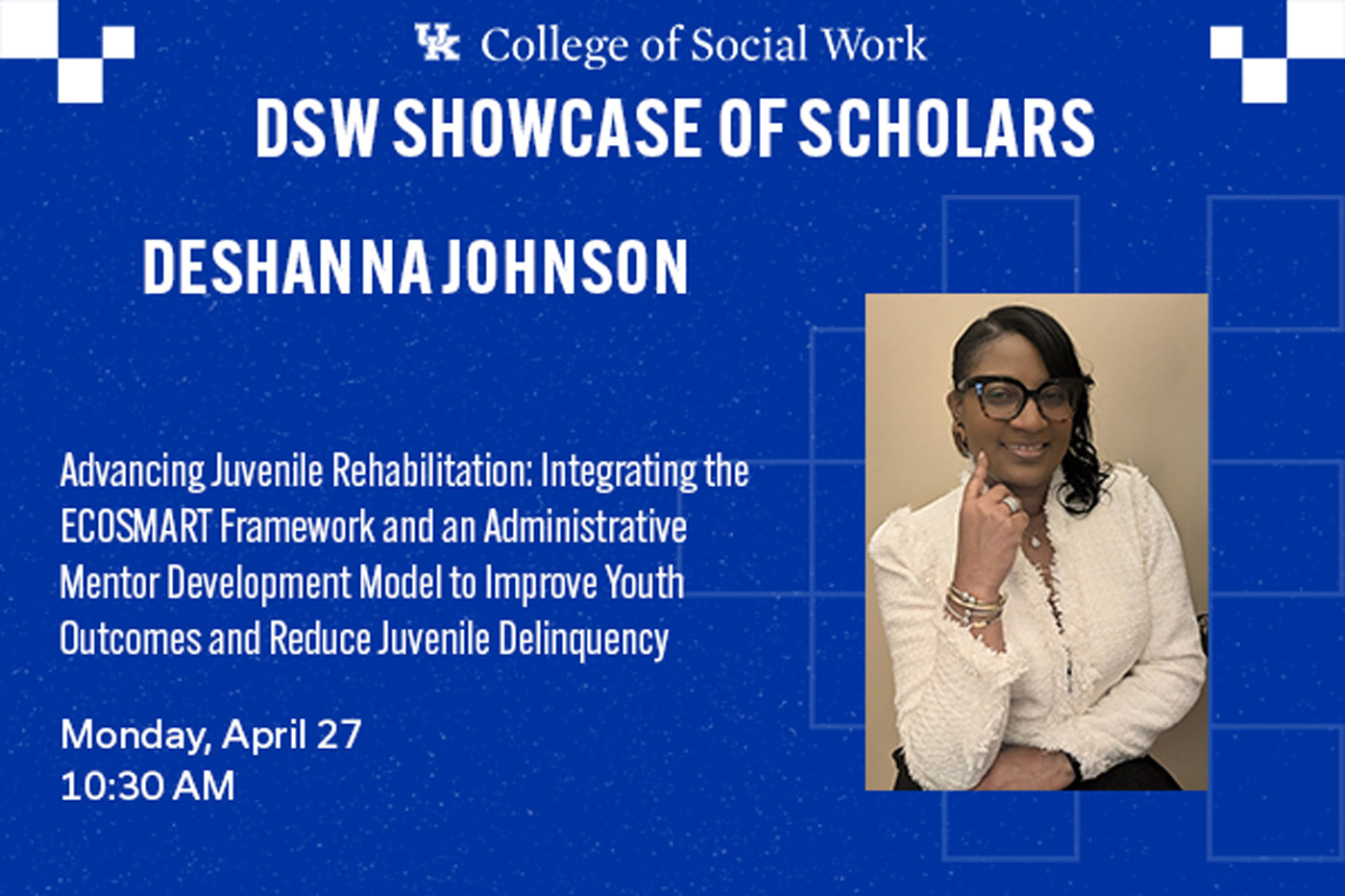
Advancing Juvenile Rehabilitation: Integrating the ECOSMART Framework and an Administrative Mentor Development Model to Improve Youth Outcomes and Reduce Juvenile Delinquency
DSW Candidate – DeShanna Johnson
Monday, April 27, 2026
10:30AM – 11:45 AM Eastern Time Zone
Credit Hours: 1.0 (ACE)
Description
Advancing Juvenile Rehabilitation: Integrating the ECOSMART Framework and an Administrative Mentor Development Model to Improve Youth Outcomes and Reduce Juvenile Delinquency
Learning Objectives:
Upon completion of this conference, participants will be able to:
- Participants will be able to summarize the ECOSMART framework and apply it to real-world juvenile case scenarios to identify how at least two ecological systems influence youths’ rehabilitation needs.
- Participants will be able to evaluate the components of an administrative mentor development model and identify two to three strategies to strengthen recruitment, training, retention, and support for culturally responsive mentors.
- Participants will be able to explain how relational, culturally responsive, trauma-informed mentoring practices that are grounded in theory can improve youth outcomes and reduce delinquency by outlining two key practice components.
Presenter Bio:
DeShanna Johnson holds a Master of Social Work degree from the University of North Carolina at Chapel Hill and a Bachelor of Arts degree in Criminal Justice from Shaw University. DeShanna is a Doctor of Social Work (DSW) candidate at the University of Kentucky. Her capstone topic focuses on “Advancing Juvenile Rehabilitation: Integrating the ECOSMART Framework and an Administrative Mentor Development Model to Improve Youth Outcomes and Reduce Juvenile Delinquency.”
DeShanna’s qualifications and experience attest to her expertise in the field. DeShanna is employed at Bridges Juvenile Crisis and Assessment Center as a Licensed Clinical Social Worker (LCSW) and a Licensed Clinical Addiction Specialist (LCAS). She is also a Certified Life Coach (CLC). DeShanna has provided services to diverse populations, including adolescents, adults, groups, and families. Her clinical experience spans various settings, including integrated healthcare, substance use outpatient specialty clinics, crisis intervention, inpatient psychiatric facilities, and non-profit organizations. DeShanna made significant contributions to social work as a field instructor at The University of North Carolina at Chapel Hill and East Carolina University, providing clinical supervision to graduate-level social work students.
Upon completing her Doctor of Social Work (DSW), DeShanna aims to empower adolescent girls by fostering resilience and equipping them with the skills needed for success. As the founder of Girls In Motion, a nonprofit mentoring program for adolescent girls, she intends to use her research to implement a sustainable, holistic framework that is relational, trauma-informed, culturally responsive, and focused on long-term results that effectively address rehabilitation needs.
Delivery Method: Live Interactive Training via Zoom Video Conferencing
Credit Hours: 1.0 (ACE)
Target Audience: This conference is intended for social workers and students.
Accreditation: University of Kentucky College of Social Work, Provider # 1377, is approved as an ACE provider to offer social work continuing education by the Association of Social Work Boards (ASWB) Approved Continuing Education (ACE) program. Regulatory boards are the final authority on courses accepted for continuing education credit. ACE provider approval period: 9/29/25-9/29/28. Social workers participating in this conference will receive up to 15 general continuing education credits.
Claiming CE Credit: Instructions for claiming CE credit will be disseminated at the beginning of each session.
Questions: If you have any questions regarding CE credit or to report a grievance, please contact Christina Krantz at Christina.Krantz@uky.edu. For technical assistance, please contact lmshelp@uky.edu.
Disclaimer: The views and opinions expressed in these presentations are those of the individual presenters and do not necessarily reflect the official policies or positions of the University of Kentucky or the College of Social Work. The inclusion of any topics, perspectives, or discussions is intended for academic engagement and does not constitute endorsement by the institution.