DSW Candidate – Aleisha Morris
$0.00
Virtual Showcase of DSW Scholars 2026 Event!
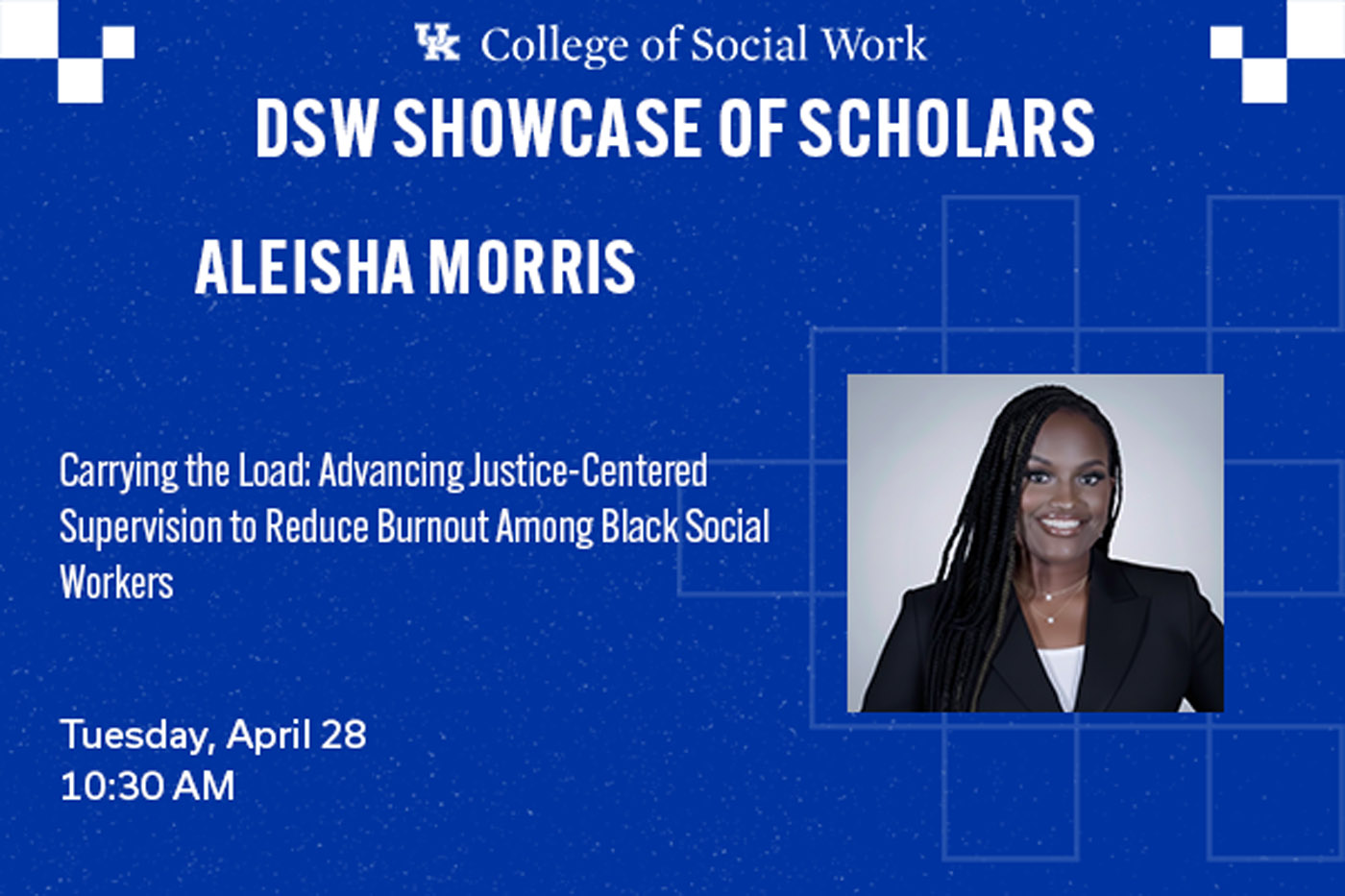
DSW Candidate – Aleisha Morris
Tuesday, April 28, 2026
10:30 AM-11:45 AM Eastern Time Zone
Credit Hours: 1.0 (ACE)
Description
Carrying the Load: Advancing Justice-Centered Supervision to Reduce Burnout Among Black Social Workers
Learning Objectives:
Upon completion of this conference, participants will be able to:
- Identify organizational and supervisory factors that contribute to burnout among Black social workers in high-stress practice environments.
- Explain how Black Feminist Thought and Organizational Justice Theory inform justice-centered supervision practices.
- Evaluate supervision as a structural intervention for promoting resilience, retention, and ethical social work practice.
- Apply justice-centered supervisory strategies to enhance support, accountability, and well-being within social work organizations.
Presenter Bio:
Aleisha Morris, MSW, LCSW, is a Doctor of Social Work candidate at the University of Kentucky in the Administrative Leadership track. She holds a Bachelor of Science and a Master of Science in Criminal Justice from Southern University and A&M College, as well as a Master of Social Work degree from Tulane University. Aleisha is a Licensed Clinical Social Worker with professional experience spanning school social work, behavioral health, and community-based practice across diverse populations. She currently serves as a Behavioral Health Specialist at Oak Street Health/CVS Health, where her work centers on assessment, intervention, and care coordination within high-stress service environments.
Aleisha’s scholarly interests focus on burnout, racialized workplace stress, organizational culture, and leadership practices within human service systems. Her capstone project, Carrying the Load: Advancing Justice-Centered Supervision to Reduce Burnout Among Black Social Workers, examines how organizational inequities and traditional supervision models contribute to burnout among Black social workers in high-stress settings. Grounded in Black Feminist Thought and Organizational Justice Theory, her work emphasizes justice-centered, trauma-informed, and culturally responsive supervision as a leadership strategy to promote resilience, workforce retention, and organizational accountability.
Through her doctoral training, Aleisha seeks to bridge research, leadership, and practice by translating evidence into actionable supervision frameworks that support practitioner well-being and sustainable service delivery. Her professional goals include advancing administrative leadership in human service organizations and contributing to social work education through teaching, training, and applied scholarship.
Delivery Method: Live Interactive Training via Zoom Video Conferencing
Credit Hours: 1.0 (ACE)
Target Audience: This conference is intended for social workers and students.
Accreditation: University of Kentucky College of Social Work, Provider # 1377, is approved as an ACE provider to offer social work continuing education by the Association of Social Work Boards (ASWB) Approved Continuing Education (ACE) program. Regulatory boards are the final authority on courses accepted for continuing education credit. ACE provider approval period: 9/29/25-9/29/28. Social workers participating in this conference will receive up to 15 general continuing education credits.
Claiming CE Credit: Instructions for claiming CE credit will be disseminated at the beginning of each session.
Questions: If you have any questions regarding CE credit or to report a grievance, please contact Christina Krantz at Christina.Krantz@uky.edu. For technical assistance, please contact lmshelp@uky.edu.
Disclaimer: The views and opinions expressed in these presentations are those of the individual presenters and do not necessarily reflect the official policies or positions of the University of Kentucky or the College of Social Work. The inclusion of any topics, perspectives, or discussions is intended for academic engagement and does not constitute endorsement by the institution.