DSW Candidate – Johnda Brumfield
$0.00
Virtual Showcase of DSW Scholars 2026 Event!
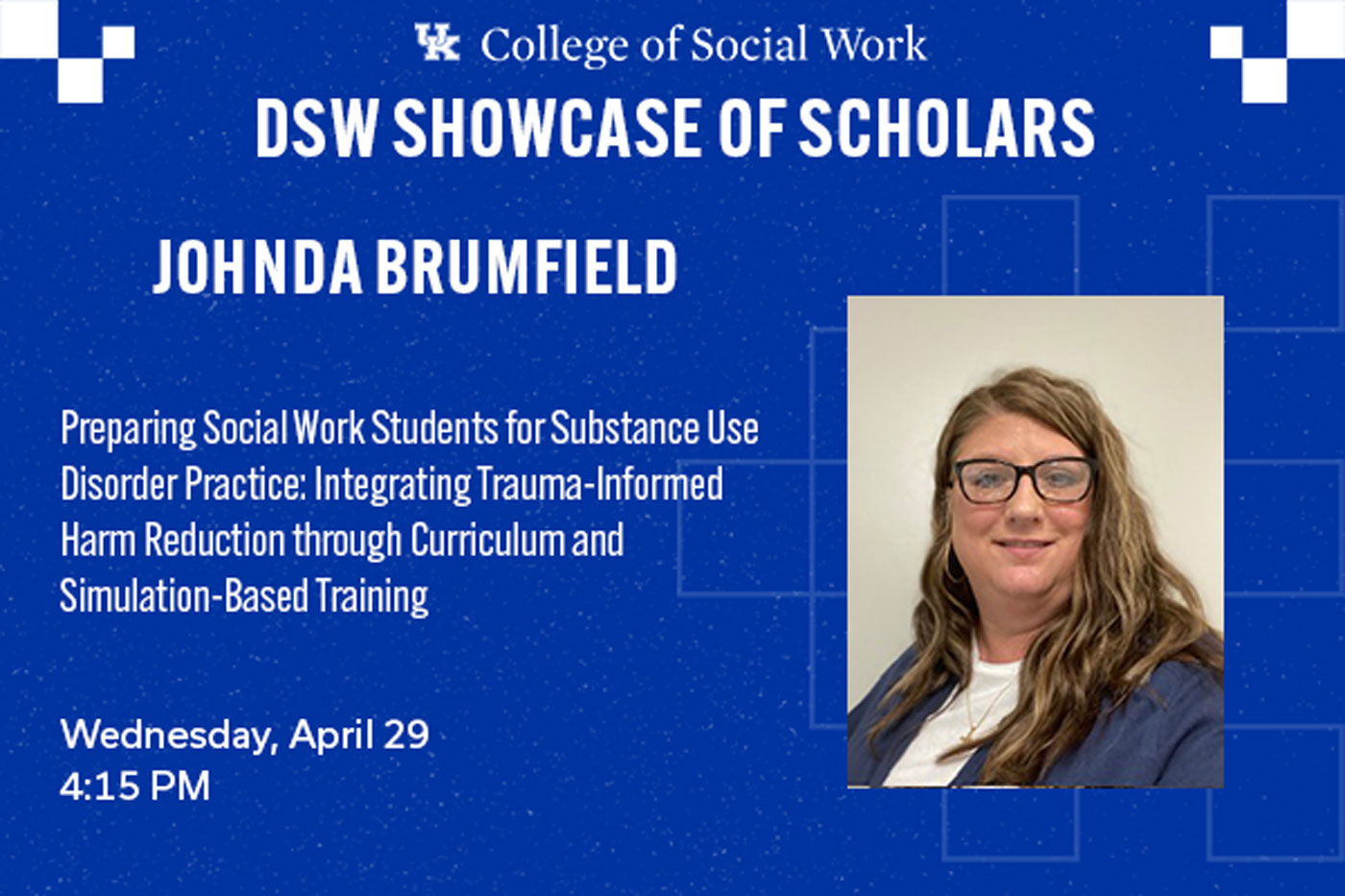
Preparing Social Work Students for Substance Use Disorder Practice: Integrating Trauma-Informed Harm Reduction through Curriculum and Simulation-Based Training
DSW Candidate – Johnda Brumfield
Wednesday, April 29, 2026
4:15PM-5:30 PM Eastern Time Zone
Credit Hours: 1.0 (ACE)
Description
Preparing Social Work Students for Substance Use Disorder Practice: Integrating Trauma-Informed Harm Reduction through Curriculum and Simulation-Based Training
Learning Objectives:
Upon completion of this conference, participants will be able to:
- Identify key gaps in social work education related to SUD-focused training, harm reduction, and trauma-informed care.
- Understand the Trauma-Informed Harm Reduction (TIHR) framework and its relevance to social work values and ethical practice.
- Identify ways to integrate SUD, HR, and TIC content into core social work curriculum and field education.
Presenter Bio
Johnda Karen Brumfield, MSW, LCSW, is a Licensed Clinical Social Worker in Kentucky and a Doctor of Social Work (DSW) candidate at the University of Kentucky. She earned her Bachelor of Social Work from Morehead State University in December 1999 and her Master of Social Work from the University of Kentucky in May 2015.
Johnda brings more than two decades of professional experience across behavioral health, addiction treatment, healthcare, counseling, crisis intervention, and case management in both residential and outpatient settings. She currently serves as the Utilization Review and Compliance Director with SPARC Recovery in Russell Springs, Kentucky, supporting individuals with co-occurring mental health and substance use disorders while ensuring agency compliance with payer authorization processes and regulatory standards.
Johnda’s Capstone Project centers on strengthening social work education and workforce readiness through the integration of a Trauma-Informed Harm Reduction (TIHR) framework across BSW and MSW curricula. Her work emphasizes preparing future social workers to respond competently and ethically to Substance Use Disorders and co-occurring mental health conditions across diverse practice settings, recognizing that substance use is frequently encountered among vulnerable populations regardless of practice specialty.
Building on this educational focus, her research interests further examine how stigma, public policy, regulatory standards, and payer-driven service delivery systems shape access to evidence informed treatment, continuity of care, and long-term recovery outcomes. Through a systems-oriented and advocacy-based lens, her scholarship supports improvements in both professional training and the broader behavioral health infrastructure impacting individuals and communities affected by addiction.
Johnda has received recognition for contributions to case management curriculum development and is currently working toward her first publication.
Delivery Method: Live Interactive Training via Zoom Video Conferencing
Credit Hours: 1.0 (ACE)
Target Audience: This conference is intended for social workers and students.
Accreditation: University of Kentucky College of Social Work, Provider # 1377, is approved as an ACE provider to offer social work continuing education by the Association of Social Work Boards (ASWB) Approved Continuing Education (ACE) program. Regulatory boards are the final authority on courses accepted for continuing education credit. ACE provider approval period: 9/29/25-9/29/28. Social workers participating in this conference will receive up to 15 general continuing education credits.
Claiming CE Credit: Instructions for claiming CE credit will be disseminated at the beginning of each session.
Questions: If you have any questions regarding CE credit or to report a grievance, please contact Christina Krantz at Christina.Krantz@uky.edu. For technical assistance, please contact lmshelp@uky.edu.
Disclaimer: The views and opinions expressed in these presentations are those of the individual presenters and do not necessarily reflect the official policies or positions of the University of Kentucky or the College of Social Work. The inclusion of any topics, perspectives, or discussions is intended for academic engagement and does not constitute endorsement by the institution.