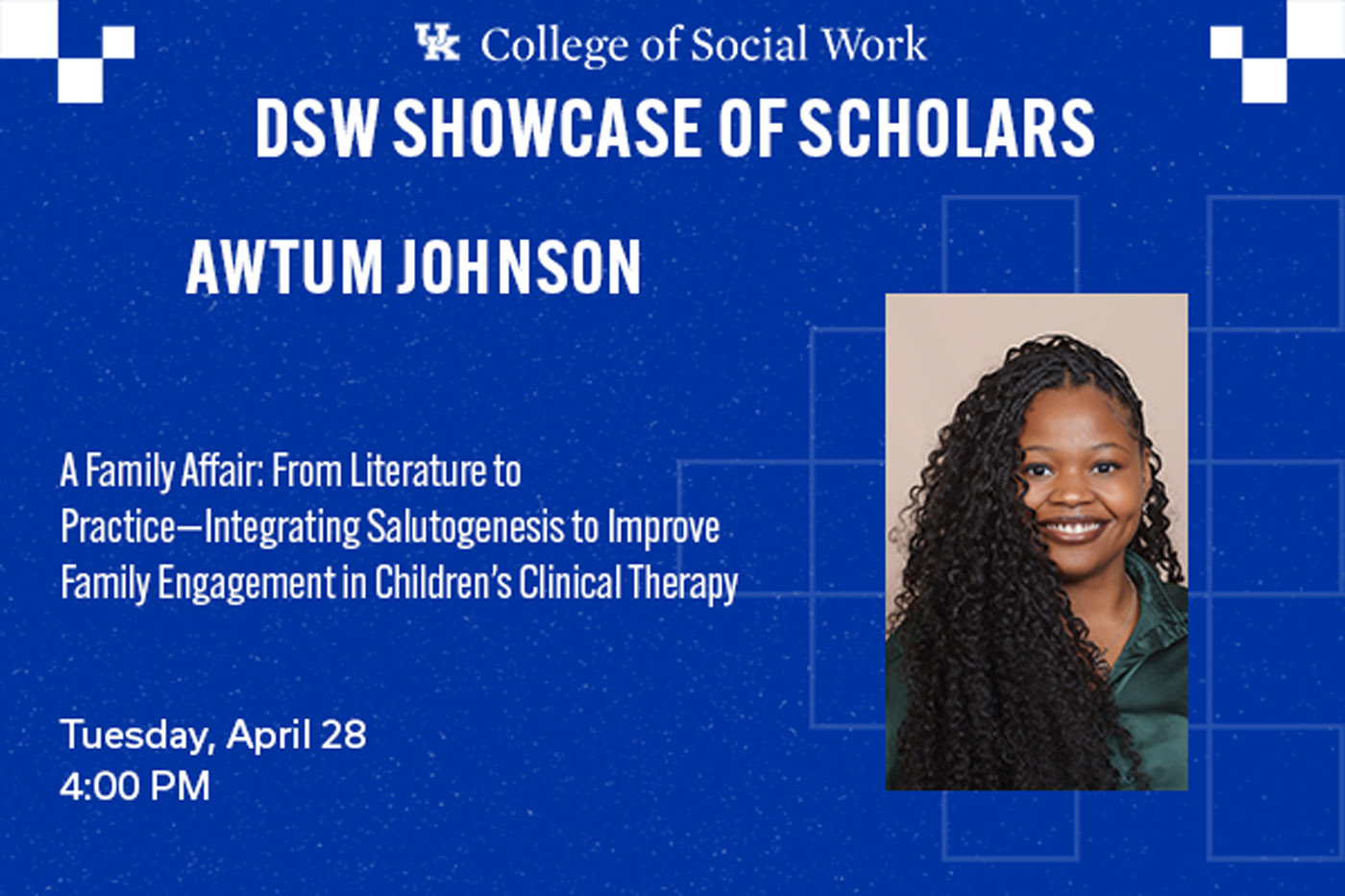
DSW Candidate – Awtum Johnson
$0.00
Virtual Showcase of DSW Scholars 2026 Event!
A Family Affair: From Literature to Practice—Integrating Salutogenesis to Improve Family Engagement in Children’s Clinical Therapy
DSW Candidate – Awtum Johnson
Tuesday, April 28, 2026
4:00 PM-5:15 PM Eastern Time Zone
Credit Hours: 1.0 (ACE)
Description
A Family Affair: From Literature to Practice—Integrating Salutogenesis to Improve Family Engagement in Children’s Clinical Therapy
Learning Objectives:
Upon completion of this conference, participants will be able to:
- Critically evaluate limitations in current family engagement models and clinical practices, including definitional inconsistencies, lack of family-level assessment, and insufficient attention to the systemic and psychosocial determinants that influence engagement and treatment dropout.
- Explain and apply principles of salutogenesis and the Sense of Coherence (SOC) to support parental coping, resilience, and sustained engagement in children’s clinical therapy settings.
- Explain how to apply the Connected Systems of Care (CSC) framework to guide family-centered assessment, resource mapping, meaning-making, and coherence-building strategies to enhance family engagement and treatment outcomes.
Presenter Bio:
Awtum Johnson is a Licensed Clinical Social Worker in Virginia and a doctoral candidate at the University of Kentucky. With a Bachelor of Arts in Psychology and a Master’s in Social Work, Awtum brings over six years of experience working with children and families in diverse environments, including schools, community organizations, and private practice. This extensive background has provided Awtum with a deep understanding of the unique challenges families face when navigating the mental health system.
Currently, Awtum serves as a Program Supervisor for an Adult Mental Health Program at a local community service board. In this role, Awtum oversees program development, staff training, and the implementation of evidence-based practices to ensure high-quality care for adults experiencing mental health challenges. Awtum’s doctoral capstone focuses on introducing and applying a conceptual framework that utilizes a holistic approach to enhance family engagement in children’s clinical therapy. The research identifies persistent barriers to maintaining family involvement throughout the treatment process, such as inflexible models and insufficient attention to family dynamics and stressors. By addressing these gaps, Awtum aims to bridge the divide in current clinical practices and offer a comprehensive, strengths-based model that empowers families as active partners in their child’s treatment and overall well-being.
In addition to clinical and academic work, Awtum has contributed to the professional community as the Membership and Finance Chairperson for the Association of Black Social Workers at the University of Kentucky Chapter, demonstrating a commitment to advocacy, leadership, and service.
Delivery Method: Live Interactive Training via Zoom Video Conferencing
Credit Hours: 1.0 (ACE)
Target Audience: This conference is intended for social workers and students.
Accreditation: University of Kentucky College of Social Work, Provider # 1377, is approved as an ACE provider to offer social work continuing education by the Association of Social Work Boards (ASWB) Approved Continuing Education (ACE) program. Regulatory boards are the final authority on courses accepted for continuing education credit. ACE provider approval period: 9/29/25-9/29/28. Social workers participating in this conference will receive up to 15 general continuing education credits.
Claiming CE Credit: Instructions for claiming CE credit will be disseminated at the beginning of each session.
Questions: If you have any questions regarding CE credit or to report a grievance, please contact Christina Krantz at Christina.Krantz@uky.edu. For technical assistance, please contact lmshelp@uky.edu.
Disclaimer: The views and opinions expressed in these presentations are those of the individual presenters and do not necessarily reflect the official policies or positions of the University of Kentucky or the College of Social Work. The inclusion of any topics, perspectives, or discussions is intended for academic engagement and does not constitute endorsement by the institution.