DSW Candidate – Athena Rowe
$0.00
Virtual Showcase of DSW Scholars 2026 Event!
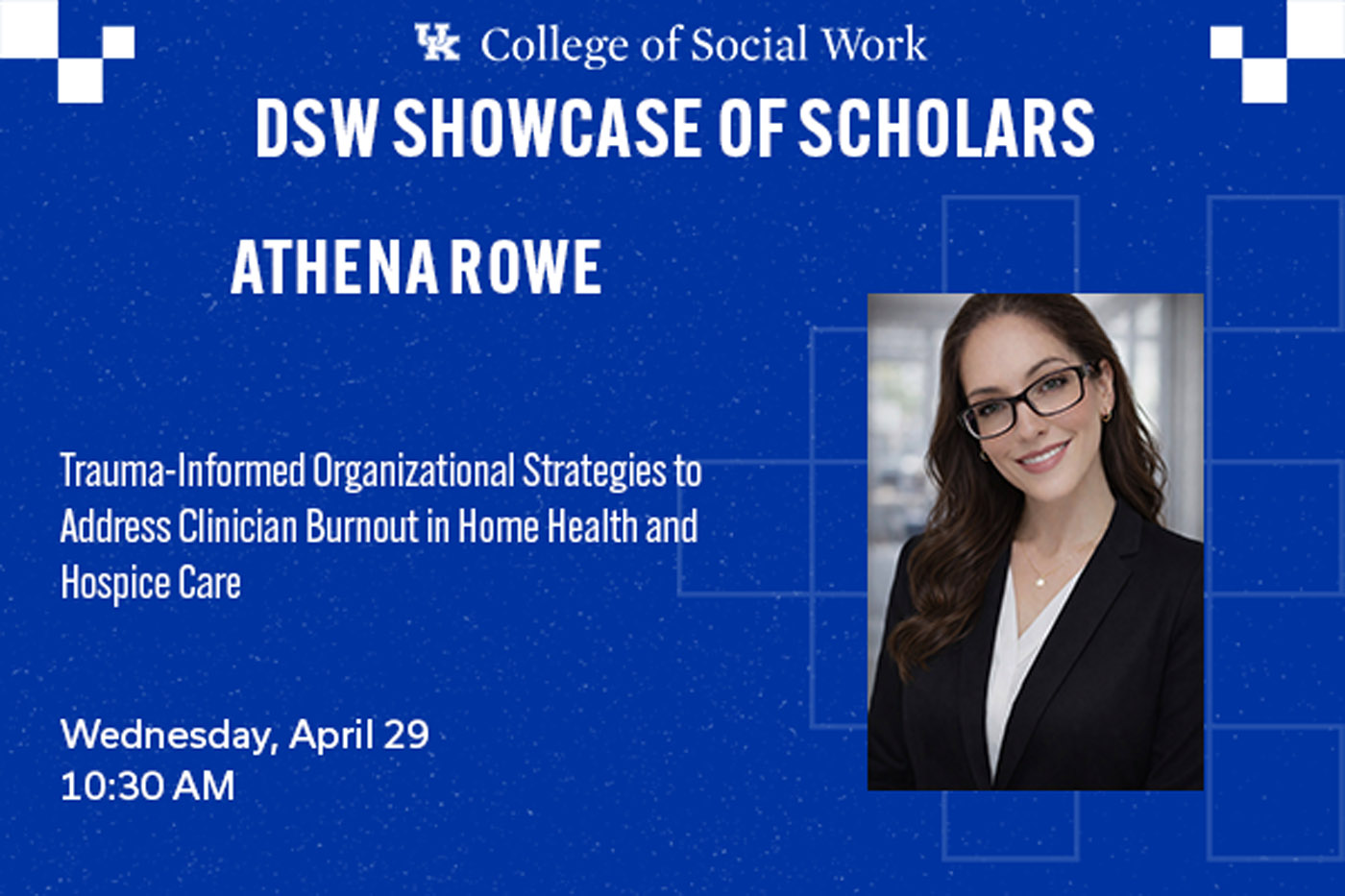
Trauma-Informed Organizational Strategies to Address Clinician Burnout in Home Health and Hospice Care
DSW Candidate – Athena Rowe
Wednesday, April 29, 2026
10:30 AM-11:45 AM Eastern Time Zone
Credit Hours: 1.0 (ACE)
Description
Trauma-Informed Organizational Strategies to Address Clinician Burnout in Home Health and Hospice Care
Learning Objectives:
Upon completion of this conference, participants will be able to:
1. Detail trauma-informed organizational principles, as well as their application to workforce sustainability in healthcare.
2. Identify chief organizational factors that contribute to secondary traumatic stress and burnout among hospice and home health clinicians.
3. Examine leadership strategies and evidence-based supervision that reduce burnout and enhance clinician well-being.
4. Apply a trauma-informed organizational framework to real-world hospice and home health practice contexts.
Presenter Bio:
Athena Rowe, MSW, RCSWI, DSW Candidate, is a Doctor of Social Work candidate at the University of Kentucky with advanced clinical experience in hospice and home health care settings. She currently practices as a medical social worker in Florida, providing psychosocial assessment, care coordination, advocacy, and interdisciplinary support to patients and families experiencing serious illness, functional decline, and end-of-life transitions. Her clinical work emphasizes trauma-informed, patient-centered care across complex healthcare environments.
Athena earned her Bachelor of Arts in Legal Studies from the University of Central Florida and her Master of Social Work from the University of Kentucky. She is a Registered Clinical Social Work Intern (RCSWI) in Florida and is pursuing her license as a Licensed Clinical Social Worker (LCSW). Her interdisciplinary academic foundation informs her approach to ethical practice, advocacy, systems navigation, and organizational leadership.
Athena’s scholarly and professional interests center on clinician burnout, secondary traumatic stress, and workforce sustainability in high-acuity healthcare environments, particularly hospice and home health care. Her capstone project examines how trauma-informed organizational interventions, rather than relying on individual resilience strategies alone, can reduce burnout, enhance workforce retention, and promote ethical practice among interdisciplinary healthcare teams.
Her work integrates trauma-informed care principles, organizational theory, ethical supervision frameworks, and system-level accountability to translate research into practical supervision models, organizational policy recommendations, and training resources. Athena’s professional goals include advancing trauma-informed organizational culture change and contributing practice-informed scholarship that promotes sustainable, equitable healthcare delivery.
Delivery Method: Live Interactive Training via Zoom Video Conferencing
Credit Hours: 1.0 (ACE)
Target Audience: This conference is intended for social workers and students.
Accreditation: University of Kentucky College of Social Work, Provider # 1377, is approved as an ACE provider to offer social work continuing education by the Association of Social Work Boards (ASWB) Approved Continuing Education (ACE) program. Regulatory boards are the final authority on courses accepted for continuing education credit. ACE provider approval period: 9/29/25-9/29/28. Social workers participating in this conference will receive up to 15 general continuing education credits.
Claiming CE Credit: Instructions for claiming CE credit will be disseminated at the beginning of each session.
Questions: If you have any questions regarding CE credit or to report a grievance, please contact Christina Krantz at Christina.Krantz@uky.edu. For technical assistance, please contact lmshelp@uky.edu.
Disclaimer: The views and opinions expressed in these presentations are those of the individual presenters and do not necessarily reflect the official policies or positions of the University of Kentucky or the College of Social Work. The inclusion of any topics, perspectives, or discussions is intended for academic engagement and does not constitute endorsement by the institution.