DSW Candidate – Caleb Williams
$0.00
Virtual Showcase of DSW Scholars 2026 Event!
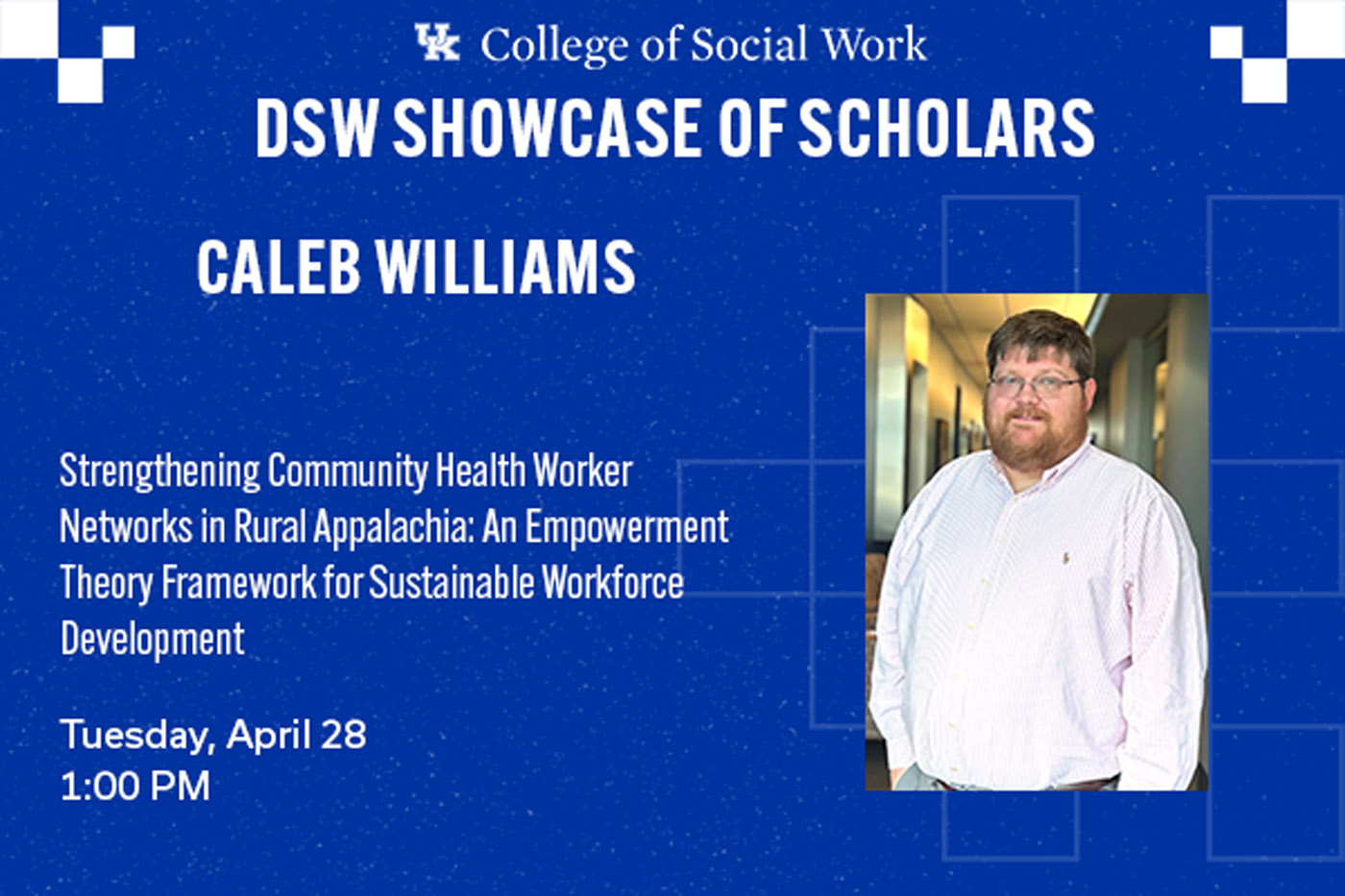
Strengthening Community Health Worker Networks in Rural Appalachia: An Empowerment Theory Framework for Sustainable Workforce Development
DSW Candidate – Caleb Williams
Tuesday, April 28, 2026
1:00 PM – 2:15 PM Eastern Time Zone
Credit Hours: 1.0 (ACE)
Description
Strengthening Community Health Worker Networks in Rural Appalachia: An Empowerment Theory Framework for Sustainable Workforce Development
Learning Objectives:
Upon completion of this conference, participants will be able to:
- Identify key challenges and evidence-based strategies for sustaining Community Health Worker networks in rural Appalachian communities.
- Explain how Empowerment Theory can be applied to enhance professional development and resilience among paraprofessional health workers.
- Analyze the role of CHWs in addressing social determinants of health and reducing disparities in underserved rural areas.
- Discuss administrative and leadership implications for implementing scalable, empowerment-focused workforce models in social work practice.
Presenter Bio:
Caleb Kincaid Williams, MHA, MSW, CSW, holds a Master of Healthcare Administration and a Master of Social Work from the University of Kentucky. He is a DSW candidate (expected May 2026) at the UK College of Social Work and is a Senior Research Data Analyst at the UK CERH. His career began in healthcare administration, progressing through clinical management and ambulatory services in Eastern Kentucky. In 2019, he joined the University of Kentucky Center of Excellence in Rural Health (UK CERH) as a Rural Project Manager, focusing on rural health initiatives. Lacking community engagement experience, he earned an MSW to build these skills. This shift sparked his interest in implementation research, blending administrative skills with culturally sensitive, evidence-based interventions to address rural disparities. Now, Mr. Williams designs and evaluates programs that promote social change, focusing on health disparities, workforce development, and social determinants in rural Kentucky. His capstone examines how rural paraprofessional networks influence social determinants and can drive lasting improvements in rural America.
Mr. Williams serves as Chair of the UK CERH External Research Committee (2025–present) and as a member of the National Rural Health Association Education Committee (2024–present). He has contributed to several federally funded projects, including the Opioid Family Support Program (HRSA-24-016) and the RURAL Cohort Study (NHLBI). Recent publications include co-authorship of the 2024 Kentucky Medical Laboratory Science Workforce Report and the 2024 Kentucky Physical Therapy Workforce Report, both published by the University of Kentucky Center of Excellence in Rural Health.
Delivery Method: Live Interactive Training via Zoom Video Conferencing
Credit Hours: 1.0 (ACE)
Target Audience: This conference is intended for social workers and students.
Accreditation: University of Kentucky College of Social Work, Provider # 1377, is approved as an ACE provider to offer social work continuing education by the Association of Social Work Boards (ASWB) Approved Continuing Education (ACE) program. Regulatory boards are the final authority on courses accepted for continuing education credit. ACE provider approval period: 9/29/25-9/29/28. Social workers participating in this conference will receive up to 15 general continuing education credits.
Claiming CE Credit: Instructions for claiming CE credit will be disseminated at the beginning of each session.
Questions: If you have any questions regarding CE credit or to report a grievance, please contact Christina Krantz at Christina.Krantz@uky.edu. For technical assistance, please contact lmshelp@uky.edu.
Disclaimer: The views and opinions expressed in these presentations are those of the individual presenters and do not necessarily reflect the official policies or positions of the University of Kentucky or the College of Social Work. The inclusion of any topics, perspectives, or discussions is intended for academic engagement and does not constitute endorsement by the institution.